01 / The short answer
Start with the surfaces your water actually touches.
A glass pour-over brewer is a straightforward place to start if you want an easy-to-inspect setup. For automatic brewing, look for a component-level materials list and check the seals as well as the tank. “Plastic-free” on a product page does not necessarily mean free of silicone, free of every polymer, or proven to reduce microplastics in your cup.
To define the scope of a claim, use the plastic free coffee maker guide. For a decision by routine, read how we choose the best coffee maker without plastic for different requirements.
Compare the three options02 / Understand the claim
What to know about plastic in coffee makers
Before choosing a coffee maker without plastic, define the part of the machine you care about. A plastic control button outside the brewing area is different from a plastic reservoir holding water. A metal case does not tell you what is inside it.
The outside
Housing, handles and controls. These may not touch the drink.
The brew path
Every surface water or coffee touches, from the reservoir through to the cup.
The small parts
Seals, valves and connectors. Ask about these even when the main parts are glass or metal.
Use “BPA-free” as a claim about BPA, not proof of the absence of plastic, BPS, PFAS or every other substance. For a specific chemical question, ask for documentation covering the exact model and contact component. We do not infer a machine’s composition from a generic study of another material or product.
Our non toxic coffee maker guide separates material specifications from release tests and health claims.
We have not obtained comparable material-release or health-outcome measurements for the machines in this guide. We make no claim that switching brewers prevents illness or produces a microplastic-free drink. Our component comparison does not answer those questions.
03 / Look inside the machine
The hard part: verifying an automatic brew path
An automatic machine can hide the very components you want to inspect. A product photo may show the carafe and basket but tell you nothing about a valve or connector. Ask for a materials list that covers both cold and hot water contact.
The specifications below illustrate why wording matters: one brand explicitly lists silicone, while another describes key metal components without giving us a complete inventory. Treat an omission as an unanswered question. It is not proof that the missing part is plastic, or that it is plastic-free.
Use the drip coffee maker without plastic checklist to request a model-specific contact-material inventory.
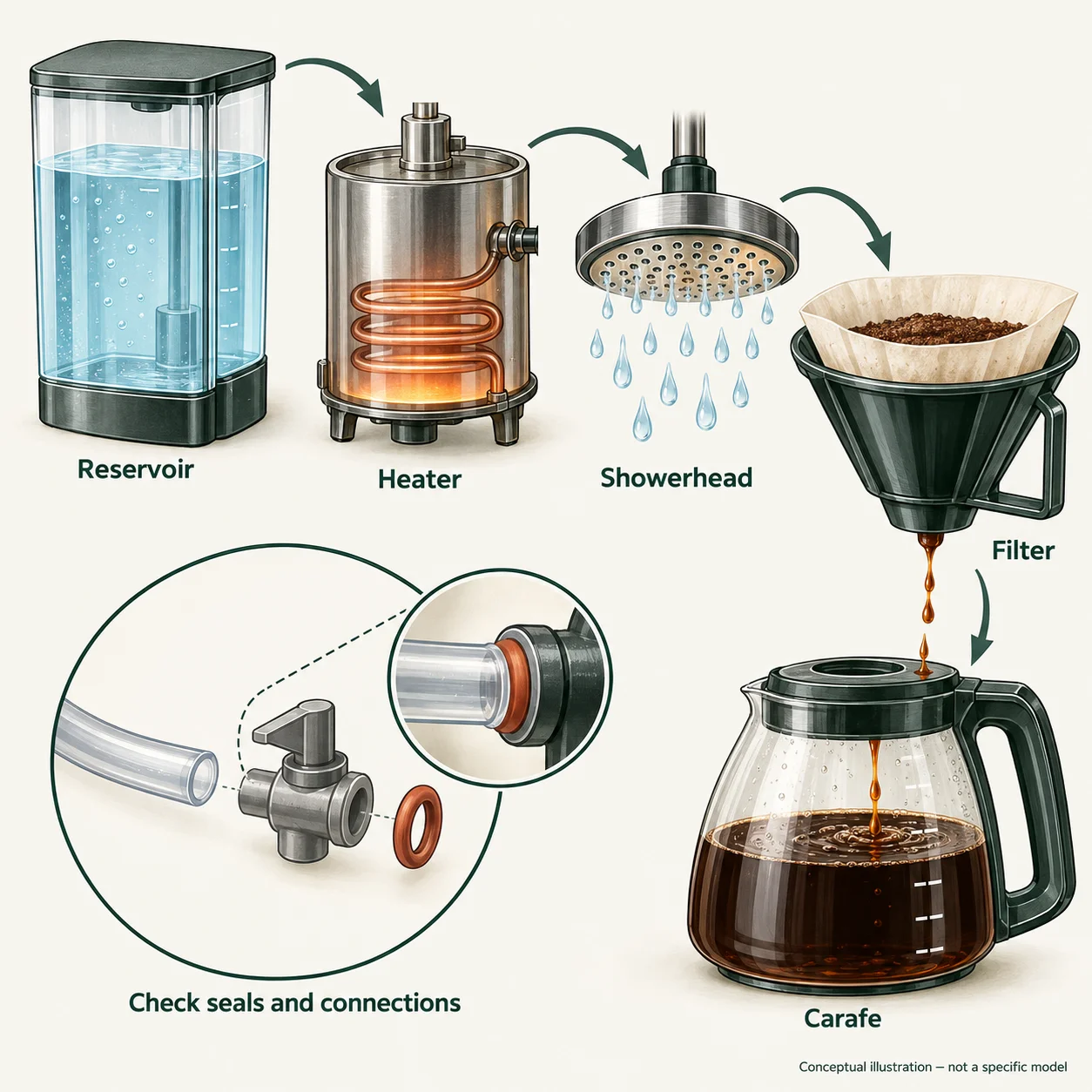
“For this exact model, what materials contact cold water, hot water and brewed coffee—including the reservoir, tubing, valves, seals, filter holder and carafe lid? Please identify any silicone, plastic or coatings.”
04 / A materials checklist
Glass, stainless steel and ceramic: what to check
These are shopping checks, not a universal safety ranking. Evaluate the finished product and its intended use, rather than treating a material name as a guarantee.
Compare the scope of a glass coffee maker claim with a stainless steel coffee maker claim. For manual brewing, assess a coffee kettle without plastic as a separate part of your setup.
- Glass: identify the vessel material and inspect lids and filter supports separately. Include your kettle when assessing the setup.
- Stainless steel: look for a documented grade and a description of the internal contact surfaces, not just a stainless exterior.
- Ceramic: check the maker’s food-contact documentation for the finished glaze. Appearance alone cannot establish its composition.
- Silicone: record where it is used. If your personal requirement excludes synthetic polymers altogether, ask specifically about silicone rather than relying on a plastic-free label.
- Filters: check the exact filter product and any material claims separately from the brewer.
Compare mainstream brewing options by component
These mainstream alternatives are included to make the materials trade-offs visible, not because all satisfy a no-plastic requirement. Identify the model and configuration before comparing claims.
AeroPress: main material and individual parts
The official AeroPress comparison gives Original a Material entry of “Polypropylene”. The same official site's Original care FAQ separately describes a removable food-grade silicone seal without adhesive. We read the Material entry as a main-material summary, then check the component disclosures. The Go entry itself names silicone for the cup lid.
Our component review separates the exterior, water-contact path, seals and filters. The columns distinguish a main-material summary from a component inventory. Identify the exact AeroPress model before comparing materials. BPA-free remains a manufacturer claim, not an independent test result.
| Model | Official Material entry (verbatim) | Component-level detail and limits |
|---|---|---|
| Original10 oz · USD $39.95 · October 2, 2026 | PolypropyleneOfficial comparison · model selector Official comparison ↗ | The product FAQ separately identifies a food-grade silicone seal, removable without adhesive. The main-material row is not a full cap, seal or filter inventory. Model documentation ↗ |
| Original XL | Polypropylene & Tritan™ CarafeOfficial comparison · model selector Official comparison ↗ | The comparison distinguishes the polypropylene brewer from its Tritan carafe. Other individual seal and cap materials remain unverified here. Model documentation ↗ |
| Clear & Colors10 oz · USD $49.95 · October 2, 2026 | Tritan™Official comparison · model selector Official comparison ↗ | Tritan identifies the main brewer material. It does not assign every cap, seal and filter material. Model documentation ↗ |
| Clear XL | Tritan™Official comparison · model selector Official comparison ↗ | The product page also identifies a 20 oz Tritan carafe. A complete seal and cap inventory is not established here. Model documentation ↗ |
| Steel | Stainless SteelOfficial comparison · model selector Official comparison ↗ | The component FAQ specifies 304 stainless steel except for the LFGB-grade silicone plunger seal. Model documentation ↗ |
| Premium | Borosilicate Glass, Stainless Steel & AluminumOfficial comparison · model selector Official comparison ↗ | The FAQ specifies double-wall borosilicate glass, an anodized aluminum flange and plunger, an LFGB-grade silicone seal, and a stainless steel filter cap. Model documentation ↗ |
| Go8 oz / 1 cup · USD $49.95 · October 2, 2026 | Polypropylene & Silicone (Go cup lid)Official comparison · model selector Official comparison ↗ | On the Go product page, the Material row names silicone for the cup lid, Features describe that lid, and the care FAQ separately identifies a removable food-grade silicone brewer seal without adhesive. These refer to different parts. Model documentation ↗ |
| Go Plus | Tritan™ & Stainless Steel (Tumbler)Official comparison · model selector Official comparison ↗ | The comparison explicitly distinguishes Tritan and the stainless steel tumbler. It does not by itself allocate every seal, lid or filter material. Model documentation ↗ |
Listed capacities and USD prices are dated manufacturer observations for the named model. Prices, stock and regional offers may change; check the linked product page.
Go: three disclosures on the same product page
The Go product page names the cup lid in its Material row and Features, and separately describes the brewer seal in its care FAQ. We keep these parts distinct when documenting the exterior, water path, seals and filters.
| Source type | Official excerpt | Component identified |
|---|---|---|
| Embedded comparison · Material | Polypropylene & Silicone (Go cup lid) Source ↗ | Polypropylene and the silicone cup lid. |
| Official Features | Travel Mug: Microwaveable, lightweight, shatterproof with silicone lid in signature red Source ↗ | The travel mug's silicone lid. |
| Official care FAQ · excerpts | “To maximize the food-grade silicone seal's life, always eject the used coffee right after brewing” … “There is no adhesive on the seal” Source ↗ | A removable food-grade silicone seal on the brewer plunger; not the cup lid. |
The excerpts describe materials and care. They do not establish independent material-release results. BPA-free is a manufacturer claim.
How to read the evidence: Official specification = a component explicitly described in a reviewed specification or manual. Manufacturer claim = an attributed product or marketing statement, not independent verification. Unknown = not established in our direct review; search snippets and third-party reports do not fill that gap.
| Model / configuration | Exterior | Water / hot-water contact path | Small parts, basket, seals and handles |
|---|---|---|---|
| Technivorm Moccamaster KBGV | Official specification: Aluminum housing; plastic is also listed in the product specification.Source 1 ↗Source 2 ↗ | Manufacturer claim: Brand describes a copper boiling element. A complete contact-layer inventory is not established here; the brew basket is plastic.Source 1 ↗Source 2 ↗ | Official specification: Automatic drip-stop basket: plastic. Seal composition remains unverified; the basket specification does not establish a complete water-path inventory.Source 1 ↗ |
| Ratio Six Series 2 — standard configuration | Official specification: Formed stainless steel body; polymer water tank.Source 1 ↗Source 2 ↗ | Official specification: Listing identifies steel, borosilicate glass, aluminum and silicone after heating begins; brewed coffee also contacts a polymer-lined basket.Source 1 ↗ | Official specification: Steel filter holder with polymer liner; polymer heat shield and catcher. Verify the exact version; older Six documentation differs.Source 1 ↗Source 2 ↗ |
| Fellow Aiden Precision Coffee Maker | Official specification: Product-level list: plastic, stainless steel and silicone. The source does not allocate every exterior panel.Source 1 ↗ | Official specification: PPO plastic is disclosed; thermal carafe is stainless steel. A complete component-by-component hot-water map remains unverified.Source 1 ↗Source 2 ↗ | Official specification: Silicone steam seal is named. Basket, lid and connector sub-materials are not fully assigned in the reviewed list.Source 1 ↗ |
| CHEMEX Classic 6-Cup — paper-filter setup | Official specification: Borosilicate glass vessel, wood collar and leather tie.Source 1 ↗Source 2 ↗ | Official specification: Glass vessel and paper filter. Separate kettle and serving cup are outside this product specification.Source 1 ↗ | Official specification: Wood/leather collar outside the vessel; any added lid or third-party filter needs a separate specification.Source 1 ↗ |
| AeroPress Steel — manual press | Official specification: The chamber and plunger are 304 stainless steel; the chamber has a double-wall construction. The FAQ lists a separate silicone seal.Source 1 ↗ | Official specification: The FAQ specifies a 304 stainless steel chamber and filter cap, with an LFGB-grade silicone plunger seal. A separate kettle, cup and any paper filter are outside this component list.Source 1 ↗ | Official specification: The cap, scoop and stirrer are 304 stainless steel; the seal is LFGB-grade silicone. The maker also claims BPA-free. This is manufacturer documentation, not independent material-release testing.Source 1 ↗ |
| AeroPress Premium — standard glass model | Official specification: Double-wall borosilicate glass chamber with an anodized aluminum flange; anodized aluminum plunger.Source 1 ↗ | Official specification: The FAQ specifies a double-wall borosilicate glass chamber, an LFGB-grade silicone plunger seal and a stainless steel filter cap. It also lists an anodized aluminum flange and plunger; it does not map every wetted surface.Source 1 ↗ | Official specification: The plunger seal is LFGB-grade silicone, the filter cap is stainless steel, and the flange and plunger are anodized aluminum. This manufacturer component list is not independent material-release testing.Source 1 ↗ |
| Able Kone — stainless filter, standard finish | Official specification: Etched stainless steel filter with polymer support ring; this is an accessory, not a complete brewer.Source 1 ↗ | Official specification: Coffee passes through the steel filter. A metal filtration surface does not make the entire assembly polymer-free.Source 1 ↗ | Official specification: Injection-molded polymer support ring is explicitly disclosed. Check its position in your chosen brewer.Source 1 ↗ |
| HARIO V60 ceramic 02 — standalone VDC-02 | Official specification: Porcelain dripper. This row covers the ceramic model, not resin V60 variants.Source 1 ↗ | Official specification: Porcelain cone; paper filter, kettle and server require their own documentation.Source 1 ↗ | Official specification: Porcelain dripper is the stated material; separately bundled accessories cannot inherit that claim.Source 1 ↗ |
| Simply Good Coffee — programmable brewer | Unknown / not verified: A complete exterior inventory was not established from the reviewed product description.Page checked — detail unresolved ↗ | Manufacturer claim: 304 steel plumbing and boiler; borosilicate glass reservoir, tube and carafe; silicone connection parts.Source 1 ↗ | Manufacturer claim: Silicone cover, lid seal, connectors and drip stop. “Plastic-free” here is not “polymer-free.”Source 1 ↗ |
| Coulée SWIRL SWL001 | Official specification: Plastic exterior surfaces are mentioned in the SWL001 manual.Source 1 ↗ | Manufacturer claim: Steel boiler and spigot are described; the complete reservoir and tubing inventory remains unverified.Source 1 ↗ | Unknown / not verified: Seal, valve and connector materials remain unverified. Ask for the exact SWL001 inventory.Page checked — detail unresolved ↗ |
| Aarke Drip Coffee Maker — US specification | Official specification: The expanded Material and product care tab lists: “Stainless steel SUS304, glass, silicone, BPA-free food-grade plastic”. BPA-free and the listed standards are manufacturer claims, not independently verified certifications. This list does not allocate every exterior panel.Source 1 ↗ | Official specification: The default setup uses a glass carafe and warming plate. The stainless steel Thermal Jug is sold separately. Internal reservoir, tubing and heater contact materials remain Unknown: an official component-material inventory was not obtained.Source 1 ↗ | Unknown / not verified: The official component-material inventory was not obtained. Anatomy describes a drip-stop at the basket bottom but does not specify its material, nor the materials of seals, connectors or the basket.Page checked — detail unresolved ↗ |
| Aarke Coffee Press — stainless steel French press | Official specification: The specification lists SUS304 stainless steel. The page separately markets the press as 100% stainless steel; that broader claim is attributed to the manufacturer.Source 1 ↗ | Manufacturer claim: The official Features section says “Made of 100% stainless steel”. We attribute that whole-product claim to Aarke; we did not find a separate “zero plastic parts” statement or independently inspect all contact surfaces.Source 1 ↗ | Official specification: The manufacturer explicitly lists a reusable stainless steel mesh filter and a stainless steel measuring spoon. A complete separate inventory of every joint is not provided.Source 1 ↗ |
| AeroPress Clear & Colors — standard model | Official specification: The official comparison identifies Tritan; the product page also identifies this plastic. A transparent or colored body must not inherit the glass, aluminum or steel specifications of Premium or Steel.Source 1 ↗Source 2 ↗ | Official specification: The listed brewer material is Tritan plastic. The reviewed page does not provide a complete part-by-part contact map; the kettle and cup are separate.Source 1 ↗Source 2 ↗ | Unknown / not verified: No complete allocation of cap, seal and accessory materials was established from this product specification. Do not copy the Steel or Premium parts list.Page checked — detail unresolved ↗ |
| AeroPress Original — polypropylene brewer | Official specification: The official model comparison lists polypropylene; the Clear FAQ also identifies the grey Original brewer as polypropylene plastic. Original must not inherit the materials of Clear, Steel or Premium.Source 1 ↗Source 2 ↗Source 3 ↗ | Official specification: The brewer body is polypropylene, as identified in the official comparison and Clear FAQ. This does not establish a complete cap-and-seal contact inventory.Source 1 ↗Source 2 ↗Source 3 ↗ | Official specification: The Original product FAQ identifies a removable food-grade silicone seal and says it has no adhesive. The cap and other accessories are not fully allocated by that statement; do not transfer the Steel LFGB specification.Source 1 ↗ |
| AeroPress Original XL — polypropylene body, Tritan carafe | Official specification: The official model comparison lists polypropylene for the brewer and Tritan for its included carafe. The entire set should not be described as one material.Source 1 ↗Source 2 ↗ | Official specification: Brewing body: polypropylene plastic; serving carafe: Tritan plastic, according to the official comparison. A separate kettle is outside this list.Source 1 ↗Source 2 ↗ | Unknown / not verified: The referenced model comparison does not assign every XL seal, cap and accessory. A complete component-material inventory remains unverified.Page checked — detail unresolved ↗ |
| AeroPress Clear XL — Tritan brewer and carafe | Official specification: The Clear XL description identifies Tritan for the clear brewer and its 20 oz carafe. This specification must not be transferred to Original XL.Source 1 ↗Source 2 ↗ | Official specification: The manufacturer names Tritan for the brewing body and included carafe. It does not provide measurements of substances or particles in the finished drink.Source 1 ↗Source 2 ↗ | Unknown / not verified: The reviewed description does not assign every XL cap, seal and accessory to a material. BPA-free is a manufacturer claim, not an independent test result.Page checked — detail unresolved ↗ |
Bodum CHAMBORD 1928-16US4 is not included: its official URL responds, but we have not obtained a directly verifiable component specification.
This table is compiled from public documentation. We have not performed hands-on testing on any model. Unknown means not established by the cited source review, not proof that a material is absent. Other publications may summarize a material as 'plastic-free' when a sealing ring or gasket is made of silicone. This table distinguishes those parts instead of summarizing them.
05 / Compare your options
Three routes to a more transparent brew path
These are candidates selected for different routines and available documentation—not winners of a taste test. We have not personally tested these products.
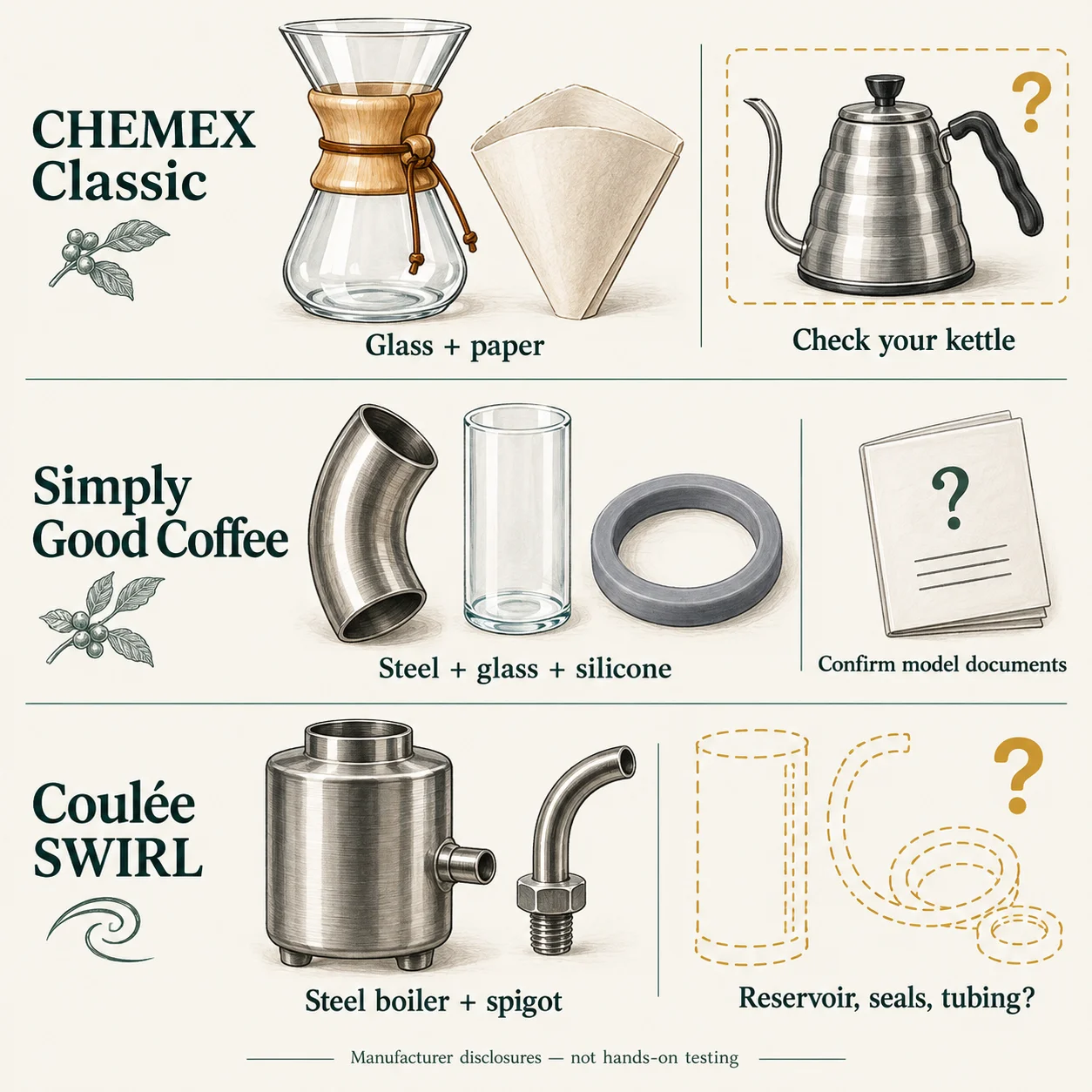
| Coffee maker | Routine | Listed price | Key limitation |
|---|---|---|---|
| CHEMEX Classic | Manual | $49.50 | Separate kettle |
| Simply Good Coffee | Scheduled drip | $469.99 | Includes silicone |
| Coulée SWIRL | Single-serve | $174.99 | Incomplete materials inventory |
USD prices are dated observations, not live offers. Verify the exact model, price, shipping and stock with the seller.
CHEMEX Classic 6-Cup
- Materials, per manufacturer
- Borosilicate glass brewer, used with a paper filter. Wood collar and leather tie sit outside the brew path.
- Capacity
- 30 fl oz
Exterior. The maker lists a wood collar and leather tie around the glass vessel. CHEMEX model page ↗
Water and coffee path. The brewer is borosilicate glass; the specified paper filter is a separate contact material. Assess the kettle independently. CHEMEX materials ↗
Small parts and accessories. Our assessment covers the standard brewer and specified filter, not an added lid or third-party attachment. Check the documentation for any accessory you use. Model scope ↗
A straightforward option if you are happy to pour by hand. The open construction makes the coffee-contact surfaces easy to inspect.
You need a separate kettle and compatible filters. Check the kettle’s water-contact materials too; the brewer alone cannot establish the materials of your entire setup.
Simply Good Coffee — The Brewer
- Materials, per manufacturer
- The maker lists 304 stainless steel for the boiler, internal plumbing, shower parts, basket and carafe top; borosilicate glass for the reservoir, boiler tube and carafe; and silicone for the reservoir cover, lid seal, connectors and drip stop.
- Capacity
- 40 fl oz / 8 maker-defined cups
Exterior. The published component list concerns water and coffee contact. It does not establish the composition of every exterior control or panel. Manufacturer component list ↗
Water and coffee path. The maker lists 304 steel for plumbing, boiler and basket, and borosilicate glass for the reservoir, boiler tube and carafe. Manufacturer materials ↗
Small parts and accessories. Silicone is disclosed for the reservoir cover, lid seal, connectors and drip stop. This is not a polymer-free specification. Silicone component list ↗
A candidate if you want a plastic-free coffee maker with a timer: the listed timer can schedule a brew up to 24 hours ahead.
The brand’s plastic-free claim includes silicone. If you want to avoid all synthetic polymers, this does not meet that stricter preference. We have not independently inspected its internals.
Coulée SWIRL Brewing System
- Materials, per manufacturer
- Coulée describes a stainless steel boiler and spigot, paired with its paper EcoPour filters.
- Capacity
- 6–12 fl oz of input water per brew, per the SWL001 manual; finished coffee volume will differ
Exterior. The official manual refers to plastic exterior surfaces. Do not describe the whole appliance as plastic-free. Support and SWIRL manual ↗
Water and coffee path. The product page identifies a steel boiler and spigot. We have not verified a complete cold-water reservoir and tubing inventory. Coulée product description ↗
Small parts and accessories. A complete seal, valve and connector materials list remains unverified in our source review. Ask about the exact SWL001 version before buying. Manual and model documentation ↗
A single-serve candidate for people comparing automated pour-over systems with fewer plastic contact surfaces.
The SWL001 manual identifies plastic exterior surfaces, and a complete reservoir, seal and tubing materials inventory is still missing. The sales page displays a sold-out/waitlist message alongside purchase controls. Confirm the exact model and stock before ordering.
CHEMEX: the maker identifies borosilicate glass and describes its filter paper as virgin pine pulp. That does not independently establish a PFAS-free or zero-release claim. Materials and filter details ↗
Simply Good Coffee: the product page listed the programmable brewer in stock when checked. Its linked shared manual is dated August 2024 and gives a different power rating from the current listing. The linked 2022/2023 analysis concerns the Olson brewer and brewing performance; it does not establish material-release results for this programmable model. Ask for model-specific documentation before relying on certification claims.
Coulée: the SWL001 manual specifies 6–12 fl oz of input water and mentions plastic exterior surfaces. This is not evidence of plastic in the hot-water path, but it rules out describing the whole appliance as plastic-free. Its cold-water reservoir, seals and tubing still need a complete materials list. Official support and SWIRL manual ↗
Our reading of the evidence: choose your preferred routine first, then decide which unresolved materials questions you are willing to accept. A less convenient machine with a clearer materials list may suit you better than an automatic machine with incomplete disclosure.
Kettles and the water path: where plastic still hides
A manual brewer does not settle the materials of its separate kettle. Check the lid underside, spout, temperature probe and fittings, then ask which surfaces touch water or returning condensation.
These two examples show why a steel body is not a complete component list. We reviewed public documents and have not handled or tested either kettle. Neither is presented as a verified entirely plastic-free choice.
Fellow Stagg Stovetop — a documentation example
Exterior. Fellow describes 304 steel, painted matte finishes or PVD polished finishes, and nylon handles and lid pulls. Fellow stovetop materials ↗
Water path. The steel description alone is not a complete inventory of the lid assembly and every contact fitting. Confirm those details for the version you are considering. Scope of the material description ↗
Small parts. The cited materials article does not settle every thermometer fitting or joint. We do not award this model a verified all-polymer-free label. Documentation to verify ↗
Fellow Stagg EKG — a disclosed mixed-material example
Exterior. Fellow discloses polypropylene in parts of the lid, handle and base; details differ by model. Fellow EKG component table ↗
Water path. The interior is described as 304 steel with a silicone ring around the temperature probe. Interior and probe materials ↗
Small parts. A silicone lid gasket is also listed. Fellow explicitly says these electric kettles are not fully plastic-free. Lid and gasket disclosure ↗
For a stovetop model, verify the lid and thermometer assembly. For an electric model, include the sensor seal and the full lid construction. Confirm the approved heat source or electrical supply for the exact version; Fellow currently states that its stovetop kettles are not induction-compatible. Do not remove seals or alter the appliance to meet a material preference.
06 / Before replacing anything
If you already own a plastic machine
You do not need to make a purchase to start investigating. Find the exact model number and its manual. List the parts that touch water or coffee, then ask the manufacturer about the ones you cannot identify.
Follow the machine’s cleaning, descaling and replacement instructions. Do not remove seals or modify internal plumbing to eliminate a material. If you decide to switch, compare the complete setup—including the kettle, filter and cup—against your own requirements.
A replacement can satisfy a materials preference. This guide cannot promise that it will improve your health.
Questions about materials and microplastics
What is the healthiest coffee maker without plastic?
We cannot identify a healthiest model from material lists. We have no comparative health-outcome evidence for these products. Use the component table to compare documented contact surfaces and unknown parts, without translating that comparison into a health ranking. For this comparison, choose a brewing routine first and read the documented contact surfaces for the exact model.
What coffee makers don't release microplastics?
We cannot certify any model here as releasing none. Our source review is not a release test, and a material name does not supply a particle measurement. We would need comparable model-specific testing before making that claim.
Is there a coffee maker that isn't made of plastic?
A CHEMEX glass brewer is one example of a non-plastic brewing vessel. That does not describe every accessory or the full setup. Automatic appliances need a component-by-component check, including seals and tubing.
How to brew coffee without microplastics?
We cannot offer a method proven to eliminate them. If your aim is less plastic contact, document the kettle, brewer, filter and cup, then choose materials that match your preference. This checklist does not measure the particles in a finished drink or establish a health benefit.
Are these hands-on coffee maker reviews?
No. We compare manufacturer specifications and public documentation with AI assistance. We have not performed flavor, reliability or material-release testing.
08 / Show the work
Sources and research method
We checked these primary sources on September 28, 2026. Manufacturer statements are attributed claims, not independent verification. Our recommendations explain the practical trade-offs we infer from them.
- CHEMEX product details ↗
- Simply Good Coffee specifications ↗
- Coulée product details ↗
- CHEMEX: Materials & Process ↗
- Simply Good Coffee: shared manual (August 2024 PDF) ↗
- Simply Good Coffee: Olson brewing analysis (2022/2023 PDF) ↗
- Coulée: Support, FAQs and SWIRL manual ↗
We have not inspected the products, analyzed samples or assessed owner-review datasets. Certifications and “zero release” claims are not independently established here. The homepage diagram and AI-generated article illustrations explain concepts and material categories. They are not product photographs, verified internal layouts or evidence of hands-on testing.
More about our editorial approach